Many students, myself included, go to college for the sake of optionality, and to delay the task of thinking of what we want out of life for another four years as opposed to doing the thing. This can be more of a curse than a blessing. It is a form of procrastination. Not always a bad one, but it is important to recognize. If you stay in the bath of optionality too long, decision paralysis sets in. Faced with dozens of equally interesting doors, you pick none, watch them all close.
As a child I never had an obvious disposition toward anything beyond a bias toward action on the rare occasion I mustered up conviction. The closest I ever got to being pushed into anything was a teacher freshman year of high school who noticed I had a lot of energy, could consume information quickly, wrote fast and semantically sound (which I appear to have lost), and started nudging me toward journalism competitions—but even that was always a suggestion, and it was always my choice to compete. Whether it's good or bad that I never had an obvious thing in front of me, I'm not sure. But what mattered is that I've chosen to do things either way.
I'll soon begin a quest at Flapping Airplanes that feels even less intuitive than my journalism competitions, but I've chosen to care enough about the quest and the unique aesthetic contribution we'll have to the world. I'm slowly stripping myself of the optionality I had freshman year. And there is a freedom in that: choosing to reject the gluttony of keeping every gem in front of you, and committing your energy to the one or two you think you can turn into gorgeous jewelry.
After catching glimpses of what I believe to be the inner rings of all fields that interest me, that no path will ever be obviously good enough. At some point, you just have to choose something that feels arbitrary, because its value comes from the energy and care you decide to give it.
Life is a canvas. You are given a handful of brushstrokes to fill it with. Some will be bolder than others, but in the end they are all just strokes you had enough conviction and directed energy to make. Choose a path that clears your minimum threshold for satisfaction, narrow your peripheral vision, and charge. If you feel you have too many paintbrushes dangling before you and cannot decide, you are choosing to leave the canvas blank.
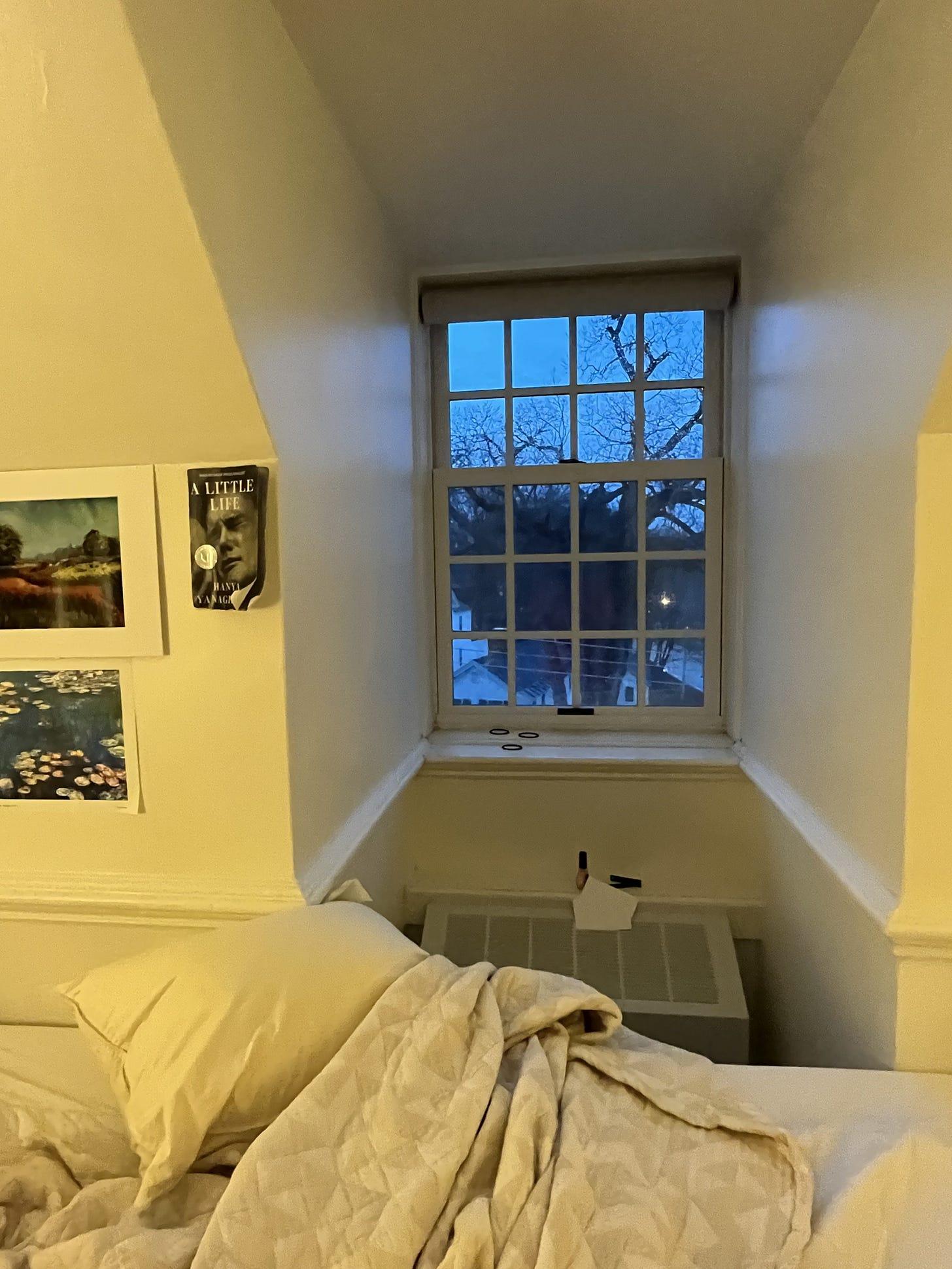
My room from boarding school, 11th grade